Français
 Italiano
 Español
 Русский язык

What Size Mini Skid Steer Loader Do You Need for Your Worksite?
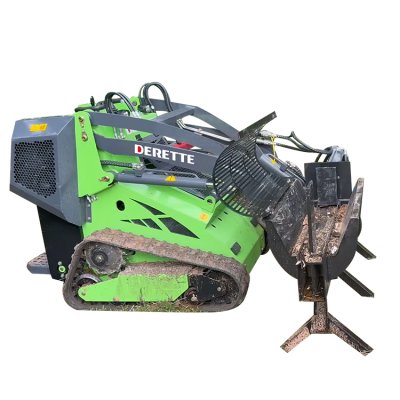
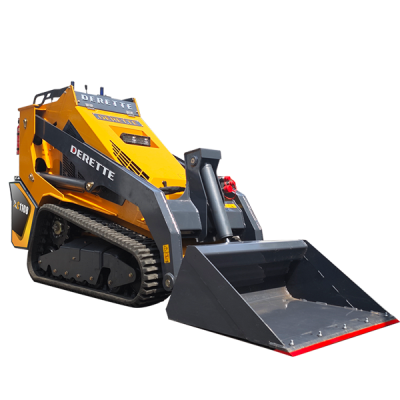
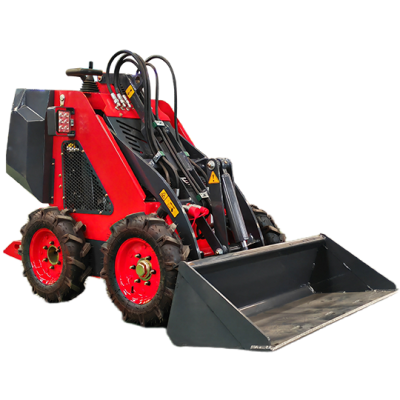
The right mini skid steer loader size is the one that fits the complete worksite—not simply the machine with the smallest footprint. Buyers should compare the loader’s overall dimensions, available access route, turning space, operating visibility, ground conditions, transport plan, and intended configuration before selecting a model.
If you are asking, “What size mini skid steer loader do I need?”, begin by measuring the site and describing the work. A narrow residential property, an open construction area, an orchard, and a commercial maintenance site may all require different equipment considerations.
For international buyers, distributors, landscapers, contractors, and farm users, Derette can discuss mini skid steer loader configurations according to the intended site and application.
1. Measure the Access Route, Not Just the Entrance
The entrance is only one part of the access route. The loader also needs to pass through gates, corridors, side passages, slopes, turning points, and changes in ground level.
Before comparing machine sizes, record:
The narrowest point along the complete route
Gate and passage dimensions
Available height clearance
Turning points and direction changes
Nearby walls, fences, vehicles, and structures
Surface transitions and ramps
Space available for entering and leaving the work area
The narrowest point should guide the initial size discussion. However, buyers should avoid choosing a loader based on one width measurement alone. The full machine envelope, operator position, attachment interface, and working movement should be reviewed together.
For landscaping and residential projects, the loader may need to access a backyard, side passage, garden, or property boundary. For construction and farm work, the key issue may be whether the machine can move efficiently between different work zones.
2. Compare Loader Dimensions with the Working Area
A loader can fit through an entrance but still be difficult to use inside the work area. Once the machine arrives at the site, it needs enough space to position itself, travel, turn, load, push, or perform other suitable tasks.
Review:
Overall machine length
Overall machine width
Overall machine height
Operating position and visibility
Front working clearance
Side clearance
Rear clearance
Space required for repositioning
Clearance around structures and people
The required working area depends on how the loader will be used. A contractor working along a fence may need careful side positioning. A landscaping team may need room to move between garden areas. A construction crew may need a clear route for repeated loading or surface-preparation tasks.
Product drawings and configuration information should be requested from the supplier. The dimensions shown on a general product page may not represent every available configuration.
3. Match the Travel System to the Ground and Route
Size selection is closely connected to the loader’s travel system. A buyer should confirm whether the selected machine uses tracks, wheels, or another configuration and evaluate how that system fits the planned surface.
Consider:
Soil and surface conditions
Turf, paving, gravel, or compacted ground
Slopes and uneven areas
Wet or soft sections
Travel distance between work zones
Surface sensitivity
Expected turning and repositioning
Site access after weather changes
The travel system should be considered as part of the loader’s complete worksite fit. A machine that passes through a gate may still need a suitable route and operating method once it reaches the work area.
For distributors, it is useful to ask customers where the machine will operate and how often it will move between work zones. These details help distinguish an access requirement from a broader terrain and workflow requirement.
4. Check the Operator’s View and Control Space
The size of a loader is not limited to its external dimensions. The operator also needs adequate visibility, access, and control space to position the machine safely and efficiently.
Before requesting a quotation, confirm:
How the operator enters and exits the machine
What the operator can see from the working position
Whether the front work area is clearly visible
How travel and loader functions are controlled
Whether the control arrangement suits the intended workflow
Whether the site allows safe communication with ground personnel
What documentation is available for the destination market
A compact loader may be used in areas close to buildings, fences, landscaping, vehicles, and pedestrians. The available operator view and the site’s working clearance should therefore be assessed together.
OSHA equipment guidance emphasizes the importance of safe equipment operation and appropriate conditions around construction machinery. Buyers should confirm the applicable local requirements and follow the operating instructions for the selected machine.
5. Consider Transport and the Complete Configuration
Transport planning should be part of size selection, but it should not be the only consideration. Buyers need to evaluate the loader as a complete configuration, including the machine, selected travel system, operator arrangement, and any compatible attachment interface.
Request confirmation of:
Operating weight of the quoted configuration
Overall transport dimensions
Loading and unloading requirements
Required transport equipment
Tie-down or securing instructions
Destination-market documentation
Configuration changes that may affect weight or dimensions
Technical support for the selected model
The same loader category may have different transport requirements depending on its final configuration. Buyers should ask the supplier to identify which figures apply to the exact machine being quoted.
A clear transport discussion is especially important for international distributors and contractors moving equipment between properties or project sites.
How to Decide Between a More Compact and a Larger Configuration
A more compact loader may be appropriate when access, passage width, or maneuvering space is the main constraint. A larger configuration may be considered when the worksite allows more room and the project requires a different operating arrangement or capacity level.
Use this decision framework:
Choose the more compact configuration when:
The access route contains narrow or restricted sections
The work area has limited turning space
The project involves residential or landscaped properties
The machine must work close to boundaries or structures
Site access is more important than maximum machine size
Consider a larger configuration when:
The site provides generous access and operating space
The work requires longer travel routes within the property
The project needs a different capacity or hydraulic configuration
Transport and loading arrangements can support the selected machine
The complete worksite allows safe repositioning
The correct decision depends on the complete application. Buyers should provide the site details to the supplier rather than choosing by size label alone.
Frequently Asked Questions
What size mini skid steer loader do I need?
Start with the narrowest access point, working-area clearance, ground conditions, operator space, travel route, transport plan, and intended configuration. The correct size is the one that fits the complete worksite and workflow.
How do I measure a site for a mini skid steer loader?
Measure the full route from the staging area to the work zone, including gates, corridors, turns, slopes, height clearance, and the narrowest passage. Then compare those measurements with the complete machine dimensions.
Is entrance width enough to choose a loader?
No. Entrance width is only one factor. The loader also needs space to turn, reposition, operate, and maintain safe clearance around structures, people, vehicles, and other site features.
Should I compare operating weight as well as width?
Yes. Operating weight affects transport planning, loading arrangements, ground considerations, and the suitability of the complete machine configuration for the intended site.
Do tracks or wheels change the size decision?
They can affect how the machine fits the ground and route. Buyers should compare the selected travel system with the surface, terrain, turning requirements, and site sensitivity.
What information should I send when requesting a loader recommendation?
Provide the narrowest access width, site type, available working area, surface conditions, slopes, intended tasks, preferred travel system, destination market, and transport requirements.
Can Derette help confirm the right loader configuration?
Send Derette the site and application information. The team can discuss the relevant mini skid steer loader configuration and the dimensions, operating details, and technical documents that should be confirmed before purchase.