Français
 Italiano
 Español
 Русский язык

Root Rake Grapple vs Standard Hydraulic Grapple: Which One Is Right for Your Project?
When it comes to land clearing and debris management, choosing the right attachment for your mini skid‑steer often determines whether a project can be finished in hours or drag on for days. At Derette, we are frequently asked one question: “What exactly is the difference between a Root Rake Grapple and a standard Hydraulic Grapple?”
While both use hydraulic power to secure loads, they differ greatly in engineering design and intended applications. Below is a professional comparative analysis to help you make the optimal choice for your fleet.
1.Root Rake Grapple: The Land Clearing Specialist
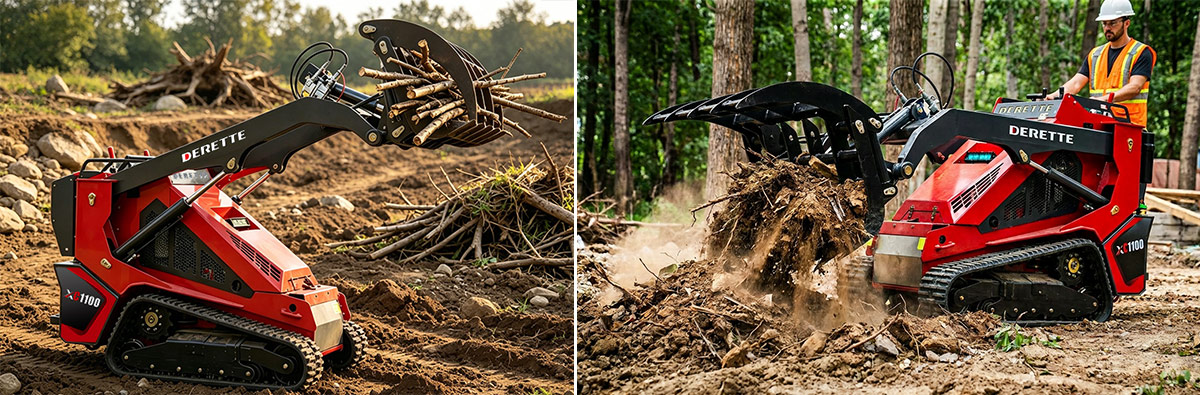
The Root Rake Grapple is engineered for aggressive ground‑level work. Its most prominent feature is long, curved tines that easily penetrate soil.
Engineering Design: It features a grate‑style base with forward‑curved tines. This allows operators to drive the attachment into the ground to pull out stubborn roots, vines and saplings.
Sifting Advantage: The core strength of the Root Rake Grapple lies in its sifting capability. When grabbing brush or roots, the open‑tine design lets valuable topsoil fall back to the ground.
Best Applications:
· Extracting roots and clearing wasteland
· Renovating and restoring orchards and vineyards
· Gathering loose brush and storm debris without removing soil
· Preparing clean seedbeds for landscaping projects
2. Standard Hydraulic Grapple: The Material‑Handling Workhorse
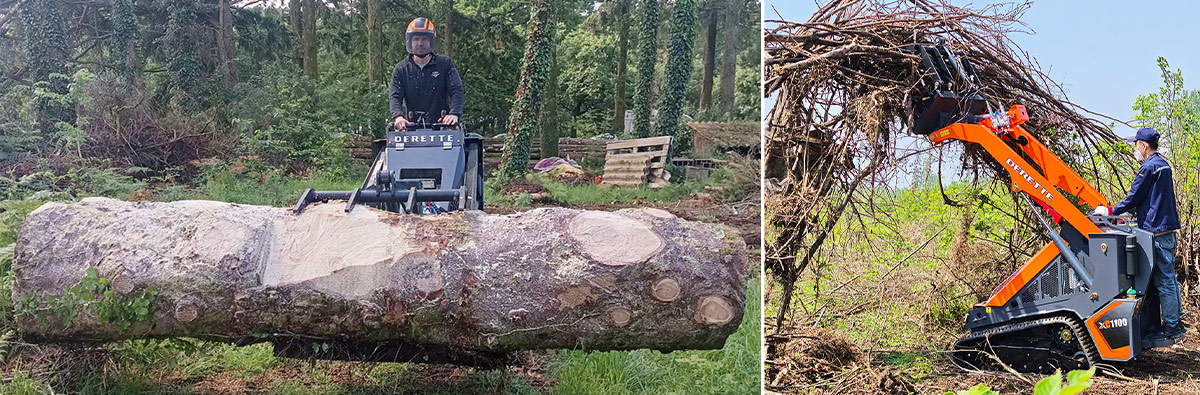
Standard hydraulic grapples (also commonly known as industrial grapples or bucket‑style grapples) are designed to pick up, place and transport materials that are already on or above the ground.
Engineering Design: These grapples generally feature a flat bottom, straighter tines. Their design prioritizes volume and holding capacity rather than soil penetration.
Secure‑Gripping Advantage: If the root rake is built for ground clearing, the standard hydraulic grapple is made for moving bulk piles. It is optimized to firmly grip large, irregular objects such as logs, boulders or scrap metal, holding them securely against its base.
Best Applications:
· Demolition site cleanup (handling concrete chunks, rebar and timber)
· Scrap yard management and waste disposal
· Moving large single logs or boulders
· General construction site cleanup where all debris along the path needs removal
Which One Should You Buy?
In essence, the Root Rake Grapple and Standard Hydraulic Grapple share similar core functions—both are hydraulic grapples for material handling and site cleanup. The key difference lies in one additional feature: the Root Rake Grapple is equipped with a root-digging function, which the Standard Hydraulic Grapple does not have. Here’s a straightforward guide to help you choose based on this key distinction:
Choose the Root Rake Grapple if:
You’re a landscaper, developer, or groundskeeper who needs to not only clean up overgrown land but also remove stubborn roots, vines, or saplings. While it can handle regular debris handling just like the standard grapple, its unique root-digging capability (thanks to its curved tines and grate-style base) lets you penetrate soil and pull out roots easily—turning unruly land into clean, workable space efficiently. It also saves you time and money by sifting out soil from debris, preserving topsoil for subsequent work.
Choose the Standard Hydraulic Grapple if:
You’re a contractor focused on heavy material handling, demolition, or debris removal—scenarios where root digging is not required. It performs nearly the same material handling functions as the Root Rake Grapple, excelling at gripping and transporting logs, boulders, concrete chunks, scrap metal, or bulk debris. Without the need for soil penetration, it offers a more secure, stable transport platform, minimizing load shift during movement.