Français
 Italiano
 Español
 Русский язык

Wheel Skid Steer vs Track Skid Steer: How to Choose for Your Worksite
When comparing wheel skid steer vs track skid steer, the better choice depends on the worksite rather than a universal ranking between the two configurations. Buyers should evaluate ground conditions, surface sensitivity, turning requirements, travel routes, slope and soft-ground exposure, transport arrangements, work frequency, and the way the machine will move through the daily workflow.
A wheel skid steer may suit projects that require regular movement across firm surfaces and frequent repositioning. A track skid steer may be considered when the work involves softer ground, uneven terrain, or a stronger need to manage surface contact. The correct decision depends on the complete application and should be confirmed with the equipment supplier.
For Derette buyers, the most useful starting point is a description of the actual property, route, surface, and work sequence—not simply a request for the “best” skid steer.
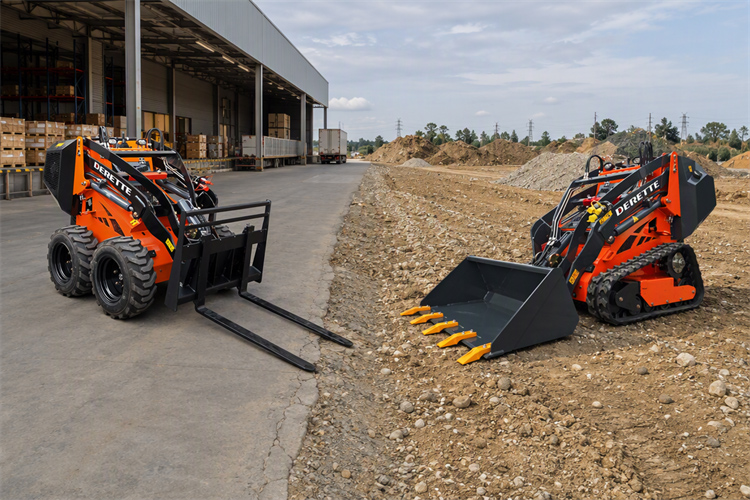
1. What Ground Conditions Will the Machine Encounter?
Ground conditions are usually the first factor to review.
Wheel skid steer considerations
A wheel-based configuration may be considered when the machine will regularly travel across:
Firm soil
Compacted construction surfaces
Concrete or paved areas
Yards and service lanes
Driveways and other hard-access routes
Worksites where frequent repositioning is required
Wheel-based machines can be relevant when the workflow includes movement between separate work zones or repeated travel over firm surfaces. Buyers should still confirm the surface suitability, turning method, traction requirements, and operating guidance for the selected configuration.
Track skid steer considerations
A track-based configuration may be considered when the worksite includes:
Soft or variable ground
Uneven terrain
Sloped sections
Landscaped areas where surface contact matters
Soil conditions that change during the project
Work areas where maintaining access is more difficult
Tracks may change how the machine interacts with the ground, but the final decision should not be based on one surface description alone. Soil moisture, slope, turning areas, load conditions, and the planned working method also need to be reviewed.
The key question is:
What surfaces will the machine cross repeatedly, and how will those surfaces change during the project?
2. How Do Wheel and Track Configurations Affect Maneuverability?
Both configurations are designed for maneuverability, but the practical result depends on the route and work pattern.
Review:
Tight turns between structures
Repositioning around landscaping or boundaries
Travel through service lanes
Movement between multiple work zones
Repeated forward and reverse travel
Alignment with the working area
Space available for turning and correction
Surface sensitivity during turns
A wheel skid steer may be considered for workflows that require frequent movement over firm surfaces. A track skid steer may be considered for terrain where ground contact and stability are more important to the work plan.
However, neither configuration should be selected only by looking at the machine’s ability to turn in place. The buyer should consider how the machine will travel through the entire property and how often the operator must reposition.
For example, a landscaping contractor may need to move between a driveway, garden area, and material staging zone. A contractor working on a construction site may need to repeatedly align the machine with a loading, grading, or surface-preparation area. These workflows may lead to different configuration priorities.
3. Which Configuration Is More Suitable for Surface Protection?
Surface protection can be an important consideration for landscaping, property maintenance, agriculture, and finished-site work.
The buyer should review:
Whether the surface is finished or unfinished
Whether turf, soil, paving, or compacted material is present
How often the machine will turn
Whether the machine must work close to landscaping
Whether the route is shared with other vehicles
Whether visible ground disturbance is a project concern
Whether the site will be restored after the work
A track-based configuration may be considered when the buyer places greater emphasis on ground contact across soft or sensitive areas. A wheel-based configuration may be considered when the machine will mainly work on firm surfaces and move frequently through established routes.
These are application-based considerations, not universal performance promises. The actual effect depends on the machine, travel system, operator method, ground condition, turning behavior, and worksite layout.
Buyers should provide photographs or a site description to the supplier when surface protection is a significant requirement.
4. How Should Slopes and Soft Ground Influence the Decision?
Slopes and soft ground can change the worksite requirements.
Before choosing a configuration, identify:
Sloped travel routes
Uneven access areas
Wet or recently disturbed soil
Soft ground near drainage areas
Changes in elevation
Ramps and transitions
Areas where the machine may need to stop or turn
Seasonal changes in surface condition
A track skid steer may be considered for work areas where soft or uneven ground is a recurring part of the workflow. A wheel skid steer may be considered where the machine mainly travels over firm routes and the site allows predictable movement.
The buyer should not treat tracks as a substitute for site planning. The operator still needs a suitable route, working clearance, visibility, and safe operating method. Likewise, a wheel-based machine should not be excluded solely because a site includes one uneven section; the importance of that section depends on how often the machine must cross it and what work is planned there.
Ask the supplier to review:
The intended travel surface
Slope conditions
Ground firmness
Turning and stopping areas
Travel frequency
Seasonal changes
The complete operating configuration
5. What Should Buyers Consider for Transport and Daily Workflow?
Transport and workflow are often overlooked when buyers compare wheel and track skid steers.
Transport planning
The buyer should confirm:
Transport dimensions of the selected configuration
Operating weight of the quoted machine
Loading and unloading arrangements
Required transport equipment
Securing instructions
Whether the travel system changes the transport plan
Destination-market documentation
Specific transport information should come from the supplier for the exact configuration. Buyers should not rely on a general category description when arranging delivery or movement between project sites.
Daily workflow
Also consider:
How often the machine changes work zones
Whether it will travel mainly on hard or soft surfaces
Whether it operates at one site or across several properties
Whether the machine is used seasonally or continuously
Whether the work includes landscaping, construction, farming, or property maintenance
Whether the machine must share routes with other vehicles
What maintenance and ownership items should be confirmed with the supplier
A wheel skid steer may be worth considering for a workflow centered on firm-surface travel and frequent relocation. A track skid steer may be worth considering for a workflow centered on variable terrain and soft-ground access.
The right question is not simply “Which configuration is stronger?” It is:
Which travel system fits the surfaces, routes, operating frequency, and work sequence of this particular site?
Wheel Skid Steer vs Track Skid Steer: Quick Selection Framework
| Worksite question | Wheel skid steer may be worth considering when… | Wheel skid steer may be worth considering when… |
What is the main surface? | The machine mainly travels on firm surfaces | The machine regularly encounters soft or uneven ground |
How often does the machine move? | The workflow involves frequent relocation | The workflow is concentrated on variable terrain |
Is surface disturbance a concern? | The site is mainly hard-surfaced or unfinished | The site includes sensitive soil or landscaped areas |
Are slopes important? | Routes are relatively predictable and firm | Uneven or sloped ground is a recurring condition |
What is the work pattern? | The machine moves between established work zones | The machine works across changing ground conditions |
What must be confirmed? | Surface suitability, maneuverability, and transport details | Ground suitability, travel system, and operating guidance |
This table is a starting framework, not a substitute for reviewing the exact machine and worksite.
Frequently Asked Questions
What is the main difference between a wheel skid steer and a track skid steer?
The main difference is the travel system. A wheel skid steer uses wheels, while a track skid steer uses tracks. The choice affects how buyers evaluate surfaces, maneuverability, ground contact, travel routes, and worksite conditions.
Is a wheel skid steer better for hard surfaces?
A wheel-based configuration may be considered when the machine mainly works on firm surfaces such as compacted areas, paved routes, or service yards. The final suitability should be confirmed with the supplier for the intended application.
Is a track skid steer better for soft ground?
A track-based configuration may be considered when soft, uneven, or variable ground is a recurring part of the worksite. Buyers should also review slope, moisture, turning areas, and the complete operating workflow.
Which configuration is better for landscaping?
It depends on the landscaping project. A wheel skid steer may suit firm routes and frequent relocation, while a track skid steer may be considered for variable ground or landscaped areas where surface contact is an important planning factor.
Which configuration is better for farm or property maintenance?
The choice depends on the property layout, soil, travel routes, seasonal conditions, and frequency of movement. Buyers should describe the complete maintenance workflow before selecting a travel system.
Do wheels and tracks affect turning and repositioning?
They can affect how the machine interacts with the surface during turns and repositioning. Buyers should evaluate the available space, surface sensitivity, route layout, and expected operating method.
Does the travel system affect transport planning?
It may. Buyers should request the transport dimensions, operating weight, loading method, and securing instructions for the exact wheel or track configuration.
Should I choose a wheel or track skid steer based only on the attachment?
No. The travel system should be selected according to the worksite, ground conditions, machine movement, operating frequency, and complete workflow. Attachment compatibility is only one part of the configuration review.
What should I ask a supplier before choosing?
Ask the supplier to review the ground conditions, route, slopes, surface sensitivity, travel frequency, transport arrangement, operating guidance, hydraulic configuration, and any maintenance or ownership items relevant to the selected machine.